The origin, history, characteristics, usefulness, and behaviour of guinea fowl are necessary for you to know if you want to raise Guinea fowl. Have you ever wondered where this poultry bird originated from? What are Guinea fowl’s unique features? Read on to find out all the details!
Guinea fowls are native to Africa and were domesticated by Native Americans and have become popular as a pet in Europe and the United States. The bird has been bred for their meat, feathers, and egg production.
However, today, guinea fowls are rarely used as a meat source in countries that have a large poultry industry. Instead, they are often raised for their unique appearance, their beautiful plumage, and their ability to live near humans.
.png "Guinea as a pet or poultry bird?")
Origin and History of the Guinea Fowl
Guineafowl is an African native species of chicken with a long history of use and significance in multiple cultures, spanning thousands of years.
This includes being used as a symbol of fertility and abundance and is considered sacred to some religious groups.
The term Guinea fowl is used for the type of bird found in Africa, but the term Guinea hen or simply fowl is sometimes used for the same bird.
The guinea fowl was domesticated from the African jungle fowl, sometime in the Middle East. Its wild ancestor also has been referred to as the bush fowl, which is also the name given to the domestic chicken. In Europe, guinea fowl was domesticated in Australia and Greece during the early Bronze Age.
There is evidence that people kept them as pets long before European settlers arrived in the 16th century. The guinea fowl is considered a game bird in Australia, meaning they are used for food and sport.
It has many different names due to its widespread, such as the Congo Chicken, Congo Fowl, Guinea Fowl, and African Fowl. These names are derived from where the Guinea fowl was first recorded but are not commonly used.
Today, these birds are found in Australia, the United States of America, North America, Asia, and Europe.
What are Guinea Fowls?
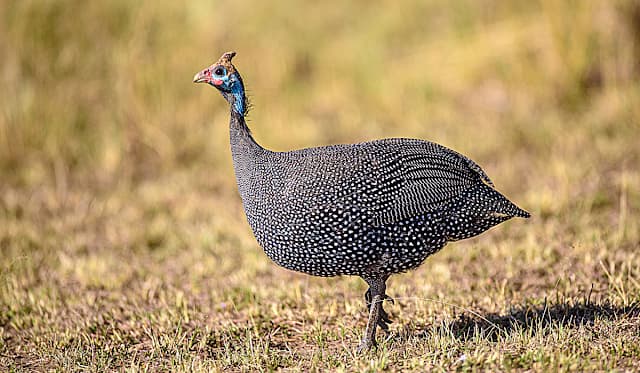
Guinea fowl are large birds with dark brown bodies and greyish plumage. It is a large, stocky bird with a large head, a short neck, and a long tail with its body covered in thick feathers.
The guinea fowl is mostly black but can have a white or greyish colouration on its head and upper back. The legs are dark grey in colour, while the rest of the body is a lighter shade of grey.
These birds have black feathers with white crests. They have long slender bills that help them to dig up tubers. They are monogamous and mate for life.
A good pair of guinea fowl will live from eight to twelve years with rapid growth at first, and then slow down a bit.
The male of this species is known as a cock while the female is known as a hen; they are very social birds and form large colonies.
Other characteristics include:
• Guineas are easy birds to tame and house.
• They are known to be friendly and docile.
• They are easy to feed and care for.
• They are also easy to train.
• They are knowledgeable and learn quickly.
• Guineas are entertaining and playful.
• Guineas are very active birds.
• They enjoy running around and chasing insects and other small animals.
.png "Labelled image of a Guinea Fowl") |
| Labelled image of a Guinea Fowl. |
Temperament & Behavior of the Guinea Fowl
This breed of poultry bird has a split personality that consists of a calm and confident female and a nervous and flighty male. Both of these personalities have an equal amount of influence on the behaviour and temperament of the Guinea fowl.
This unique personality can be attributed to the fact that the male and female Guinea fowls are identical. So, they are both of equal importance and influence on the bird’s behaviour.
The males have a bright yellow patch on their wings, which is located over their eyes, and they have large spurs on their legs. These spurs are used for defence and aggression, and they can be used to get rid of prey.
The male is territorial, and he will defend his territory from other males, but he is not aggressive towards humans, he will attack only intruders. When a human enters his territory, he will run away and scream.
The females are a little larger than the males, and they have a less colourful pattern. They do not have a yellow patch on their wings, nor do they have spurs on their legs.
The hens are slightly more aggressive than the cooks, especially if there are babies around. They will defend their nests when they see an intruder near their Keets.
Guinea fowl are good watchdogs with their loud squawking alarm call that can be heard at a distance. The Guinea fowl’s call is one of the most distinctive sounds in nature.
A female guinea will make her alarm call if she sees a predator or another bird approaching. She may also use this call to warn her mate of danger.
Their call sounds like a mixture of a cock’s crow and a cat’s meow. This call serves to warn nearby flock members about impending danger and also acts as a deterrent to keep other birds from entering their territory.
 |
| Helmet Guinea fowl |
Eggs and Guinea Keets
The guinea egg is about 25% smaller than a chicken egg. But the difference is not as noticeable when you compare the two eggs side-by-side. Both eggs have the same colour, texture, and shape.
The Guinea hen lays one egg per day, which she will then incubate for 28 days. She spends 85% of her time on eggs, only leaving them to eat, drink, and sleep. The hen will even sit on the eggs, keeping them warm and safe.
After the 28 days are up, the guinea hen will then sit on the eggs again, to ensure they hatch successfully. When they do hatch, the hen will remain with the chicks referred to as Keets until they are ready to be on their own.
The diet of guinea fowl
Guinea fowls are omnivorous, meaning they eat both plants and animals. The diet consists of vegetables, insects, meat, fruits, seeds and nectar. However, if you’re raising guinea fowls for eggs and poultry food, you may want to feed them a balanced diet.
In this case, I recommend feeding them the layer ration. It is a combination of whole grain, corn, wheat middling, soybean meal and a vitamin supplement. Guinea fowls have a high calcium requirement.
This is why you must supply a calcium supplement. Make sure you give them plenty of water regularly. Read Also: A Guide to Poultry Nutrition
.jpg "Guinea fowls")
Usefulness and benefits of the Guinea Fowl
Guineas serve three purposes: eggs, meat and plumes. Guinea fowl eggs are delicious, rich in protein, contain no cholesterol and are not very greasy. Guinea fowl meat is lean and tender and has a mild flavour.
Feathers of the guineas are the best quality of any other type of feather for decorating. They can be dyed, curled and used as stuffing for pillows or toys. They are also used in making fans, combs and headdresses.
The guinea fowl is a popular pet because it is small and can be kept as an indoor or outdoor pet. Some people find it easier to keep a guinea fowl inside, but they will need access to outside space if you plan to let them out.
Health benefits of guineas
There are several health benefits to eating guinea fowl, including
• They are used as a natural pest control because they can eat insects.
• It is an excellent source of protein.
• It is also a great source of vitamins, minerals, and omega-3 fatty acids.
• Guinea fowl is also very low in fat, which means it is a healthy food for people who want to lose weight.
• Guinea fowls are a symbol of fertility and happiness in certain countries.
• These birds also provide a natural source of fertilizer, which can help to improve the fertility of the soil.
Guinea fowl are great pets that bring happiness to your home. They are friendly, quiet, and low maintenance. They have lots of other purposes, such as:
1. Eating pests from your garden and lawn
2. Preventing rodents from chewing through your insulation
3. Helping reduce mosquito bites during the summer
4. Attracting other birds to your yard
5. Helping deter other animals from eating your food
6. Providing entertainment for children and pets
7. Helping keep your home clean and smelling good
8. Making a great conversation piece
Types of Guinea Fowl.
Guinea fowls are a member of the Phasianidae family. This group includes the pheasant family, the partridge family, and the turkey family.
Several species of guinea fowls vary in terms of size, colour, and feathers but the one with a long history of domestication is the helmeted guinea fowl (Numida meleagris), which has a feathery plume that covers most of its head.
.jpg "Silver Guinea fowl (Numida meleagris)") |
| Numida meleagris (Silver Guinea fowl) |
The largest type of the N meleagris species is the “Silver Guinea”. It has a white head, a red face, a brown back, and a green belly.
Another common type of guinea fowl is the “Blue Guinea”. It has blue-grey feathers on its head and neck and a blue body.
There is another type called the “Pale Green Guinea”. It is a small breed of guinea fowl that is dark green on the head and neck. It has light green feathers on its back and wings.
.jpg "Guineafowl")
How to care for guinea fowl
Although Guinea fowls are not excessively high-maintenance, it’s imperative to exercise caution around your other pets as they have a tendency to scratch. It’s mandatory to keep your cats or dogs at a safe distance from these birds.
The best time to take a guinea fowl out of its coop is in the late afternoon when it’s quiet and the temperature is cooler.
If you take the guinea fowl out early in the morning or during the heat of the day, it could be too hot and agitated. You don’t want to take it outside while it’s roosting, because you don’t want to disturb it.
If your fowl have been kept together for a long time, they will be used to being separated, so they will be fine once you take them out. If your guinea fowl has never been taken outside, you should introduce them slowly.
Hardiness and Health of Guinea Fowl
The Guineas are hardy birds that can survive in a wide range of climates and environments. They have a good ability to adapt to changing conditions and are very intelligent.
These birds are not as well-known as other poultry like chickens, but they are popular pet birds in many countries.
Guinea fowl are generally considered to be hardy birds because they can withstand extremes of weather. They can survive in hot, humid, and cold climates.
They can also tolerate a wide range of temperatures. Their ability to adapt to different environments makes it hard.
Guinea fowl have a long lifespan, they can live up to 15 years in captivity. Guinea fowl are prone to certain health issues like:
• Salmonellosis
• Coccidiosis
• Infectious coryza
• Parasites.
They can contract the disease from their wild or domestic habitat and also, and they can get it from their food. This disease can be fatal to the birds if not properly monitored. Therefore, proper hygiene and adequate biosecurity measures are necessary to protect them against sickness.
.jpg)
FAQs
1. Why is Guinea fowl a popular choice for keeping in captivity?
Guinea fowl are a popular choice in captivity because they are hardy birds that are known for their domestication and efficient production of eggs. These birds also have a long-life span, laying up to 100 eggs per year.
They are also known to be docile, intelligent, and friendly birds which makes them the perfect bird for people who want to keep poultry in their homes.
2. What are the health risks of keeping guinea fowl?
The guinea fowl is not known to have any health problems that would pose a risk to human health. But they are also susceptible to the same diseases and parasites as other birds.
They can carry and spread Salmonella, which can cause diarrhoea, nausea, and stomach cramps.
Other health risks include:
- Avian influenza (Bird flu)
- Salmonellosis
- Coccidiosis
- Infectious coryza
3. How much space should I have for my birds?
The space you have for your birds depends on the size of the cage. You want enough room for the birds to move around, but you also want to make sure that they can’t get out.
You should also consider how many birds you plan to keep. Do you want to keep one bird or several? How long do you plan to keep them? Are you interested in breeding?
When you get your birds, make sure that they have a good place to sleep. A perch that is too low will make it difficult for them to sleep comfortably.
Make sure that the perch is comfortable for your birds. It should be sturdy and not too high or too low. You can use a piece of wood or even a small branch. A perch that is too high will cause the birds to be uncomfortable.
4. What should I do if my birds get sick?
Birds can be very healthy and happy, but if they have a medical condition, then it is important to know what it is.
Birds that appear sick may not necessarily be. However, if they are, then you need to take them to a vet.
A lot of people think that birds are just pets, but they can also be carriers of diseases. They can also be infected by parasites, which are often found in the environment.
Some birds can be carriers of avian influenza, so you must make sure that your bird is healthy. If you notice any symptoms of illness, then you should take your bird to the vet as soon as possible.
If you are concerned that your bird might have a medical condition, then you should take it to the vet. You should do this even if they are not sick because you never know what they may be carrying.
5. Are guinea fowl good pets?
Yes, guinea fowl are very friendly, and they are great for beginners because they are easy to care for, quiet, easy to train, and they make great pets.
Guinea fowls are very friendly birds and are great for children. They are also known for being good pets because they do not require a lot of attention.
Summary
Guinea fowl is an African native species of chicken with a long history of use and significance in multiple cultures, spanning thousands of years.
The male and female are both identical, but they have different personalities. The male has a bright yellow patch over his eyes, spurs on his legs used for defence and aggression, and can be used to kill prey. While the female is less colourful with no spurs and they are both noisy.
Guinea fowls are omnivorous, meaning they eat both plants and animals. Feeding your guinea fowl layer ration will help them stay healthy if you want to use them for egg production.
Although guinea fowl are native to Africa, they are now farmed extensively around the world. They are also used for food, medicine, and other purposes.
Disclaimer
The information in this article is for educational purposes only and should not be considered a substitute for professional veterinary advice. Always consult with a qualified veterinarian for any health concerns or before making any decisions regarding the care or treatment of your animals.
Thanks for reading.