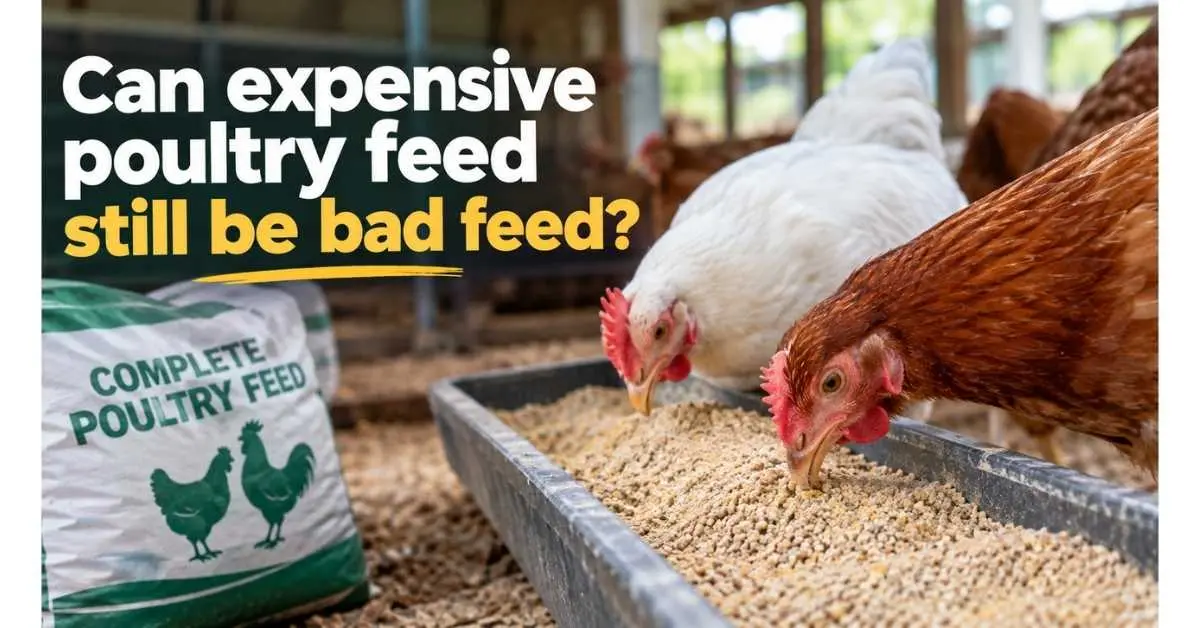
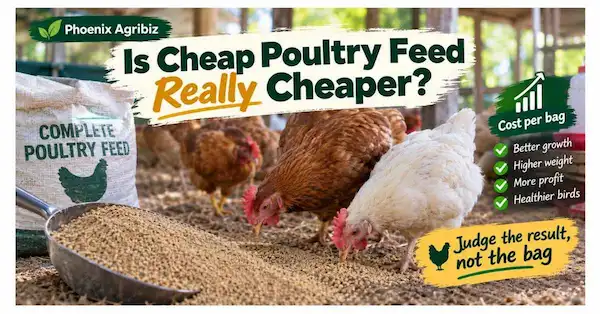
A cheaper bag of poultry feed can help your cash flow today. But that does not yet tell you whether the feed will save you money.
The real question is not “Which bag is cheapest?” It is “Which feed gives me the result I need at the lowest sensible total cost?”
This matters especially to smallholder and backyard farmers because one bad feed decision can swallow the little profit left in a production cycle.
Why bag price can deceive a farmer
Imagine two feeds:
- Feed A is cheaper per bag.
- Feed B costs more per bag.
If birds on Feed A need more kilograms of feed, take longer to reach market weight or finish lighter, the “cheap” feed may become more expensive by the time you sell.
That is why the bag price should be the beginning of your calculation, not the end.
What should I compare when buying poultry feed?
For broilers, compare:
- price per bag;
- bag weight;
- total feed used;
- average body weight;
- FCR;
- mortality;
- market age;
- feed wastage; and
- sale value.
For layers, compare:
- feed cost;
- daily feed used;
- hen day production;
- egg size and shell quality;
- cracked or rejected eggs;
- mortality; and
- cost per tray or dozen of saleable eggs.
Use cost per result, not cost per bag
A farmer makes money from meat, eggs or replacement stock: not from buying the cheapest bag.
For broilers, use the FCR Calculator after recording feed used and weight gain. It helps you see how efficiently the flock converted feed into body weight.
The broiler feeding and weight chart can help you compare feed use with growth.
A simple example
Suppose Feed A saves you money per bag but the birds take an extra week to reach the size your buyers want. During that extra week you may still pay for:
- more feed;
- water;
- labour;
- litter management;
- electricity or fuel;
- medication or health support; and
- the risk of additional mortality.
The cheaper bag may still be a good choice. But you only know after comparing the whole result.
Cheap feed does not automatically mean bad feed
This point is important.
A feed can be cheaper because the manufacturer has lower transport cost, buys ingredients well, has a different distribution system or is running a promotion. A locally available ingredient can also reduce formulation cost.
So do not condemn feed simply because it is cheap.
FAO’s poultry feeding guidance makes the broader point that economical feeding still has to meet the birds’ nutrient needs. See FAO poultry nutrition and feeding guidance.
When should very cheap feed make you careful?
If the price is far below what similar feeds cost in your area, take a closer look.
Check:
- bag weight;
- seal and labelling;
- manufacturing or batch information where available;
- mould;
- dampness;
- caking;
- insects;
- rancid or strange smell;
- damaged bags; and
- how the feed was stored.
Unusual cheapness does not prove poor quality. It simply gives you a reason to inspect before buying a large quantity.
Cheap ingredients can still make good feed
If you formulate your own feed, a cheaper ingredient may help reduce the cost of the ration. But do not replace ingredients kilogram for kilogram by guesswork.
If soybean meal becomes expensive and groundnut cake becomes cheaper, the correct question is not “Which one costs less?” The question is “What combination gives the birds the nutrients they need at a sensible cost?”
Use the Feed Cost Calculator to compare the whole 100 kg ration.
Do not save money by underfeeding
Giving birds less feed than they need is not the same thing as reducing feed cost.
You may save one bag today and lose the saving later through slow growth or extra market days. Our guide on reducing broiler feed explains the difference between cutting wastage and underfeeding.
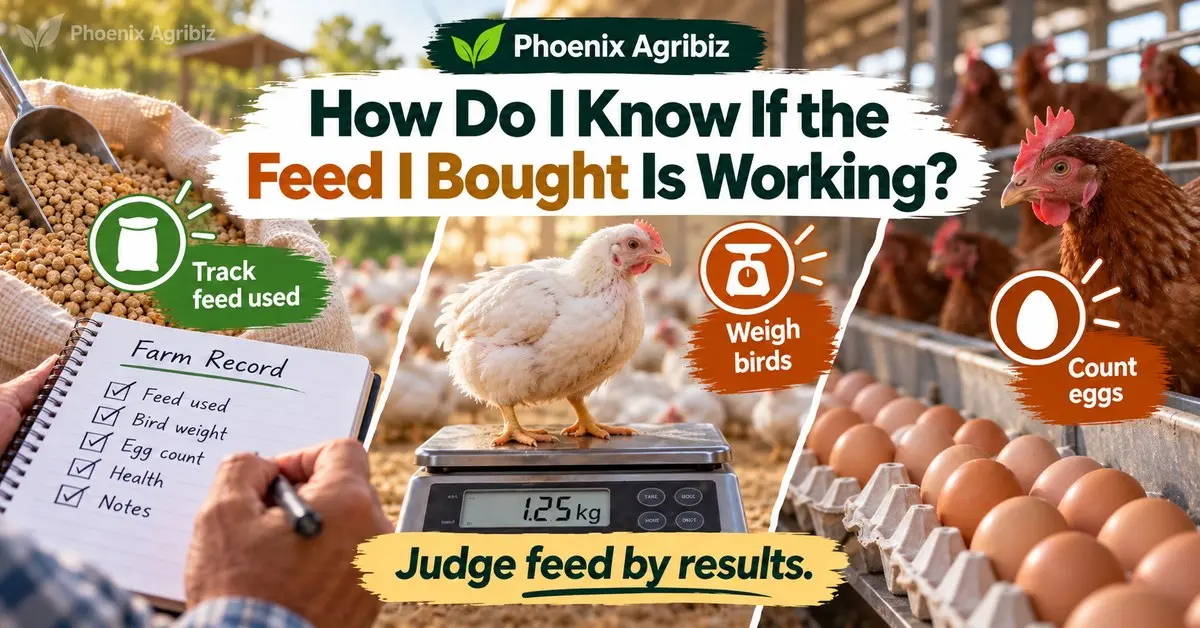
Check feed performance with your own farm records
A feed that performs well on another farm may not give exactly the same result on yours because birds, water, housing, heat, disease pressure and management differ.
Keep simple records:
- date the new feed started;
- brand and batch if available;
- quantity purchased;
- quantity used;
- weekly bird weight or daily egg output;
- mortality; and
- any major health or management problem.
If performance changes after a feed change, the records give you something to investigate.
Feed cost is a serious Nigerian farm issue
Nigerian poultry farmers regularly identify feed cost as one of the biggest pressures on profitability. Recent reporting from Nairametrics and The Guardian Nigeria shows how strongly feed and raw material prices continue to shape farm decisions.
That is exactly why farmers need to compare cost per result, not only cost per bag.
Before you choose the cheaper feed, ask these seven questions
- Is the bag weight the same?
- Does the feed match the birds’ age and production stage?
- Is the feed fresh and properly stored?
- What happened to growth or egg production when I used it?
- How much feed was needed to get that result?
- Did mortality or market age change?
- What was my final profit after all costs?
Use the Poultry Profit Calculator when you want to compare the whole production result.
The cheapest feed is not necessarily the bag with the lowest price. It is the feed that helps you produce saleable birds or eggs at the lowest sensible total cost.