A poultry farm can start losing money before the first chick arrives: if the market, budget, housing and running costs were not thought through first.
It is easy for a beginner to think poultry farming starts with choosing a flock size and buying chicks. In practice, a stronger plan works backwards from the market: What will I sell? Who will buy it? How much working capital can I carry? What happens if feed prices rise, birds grow slower than expected, or buyers delay?
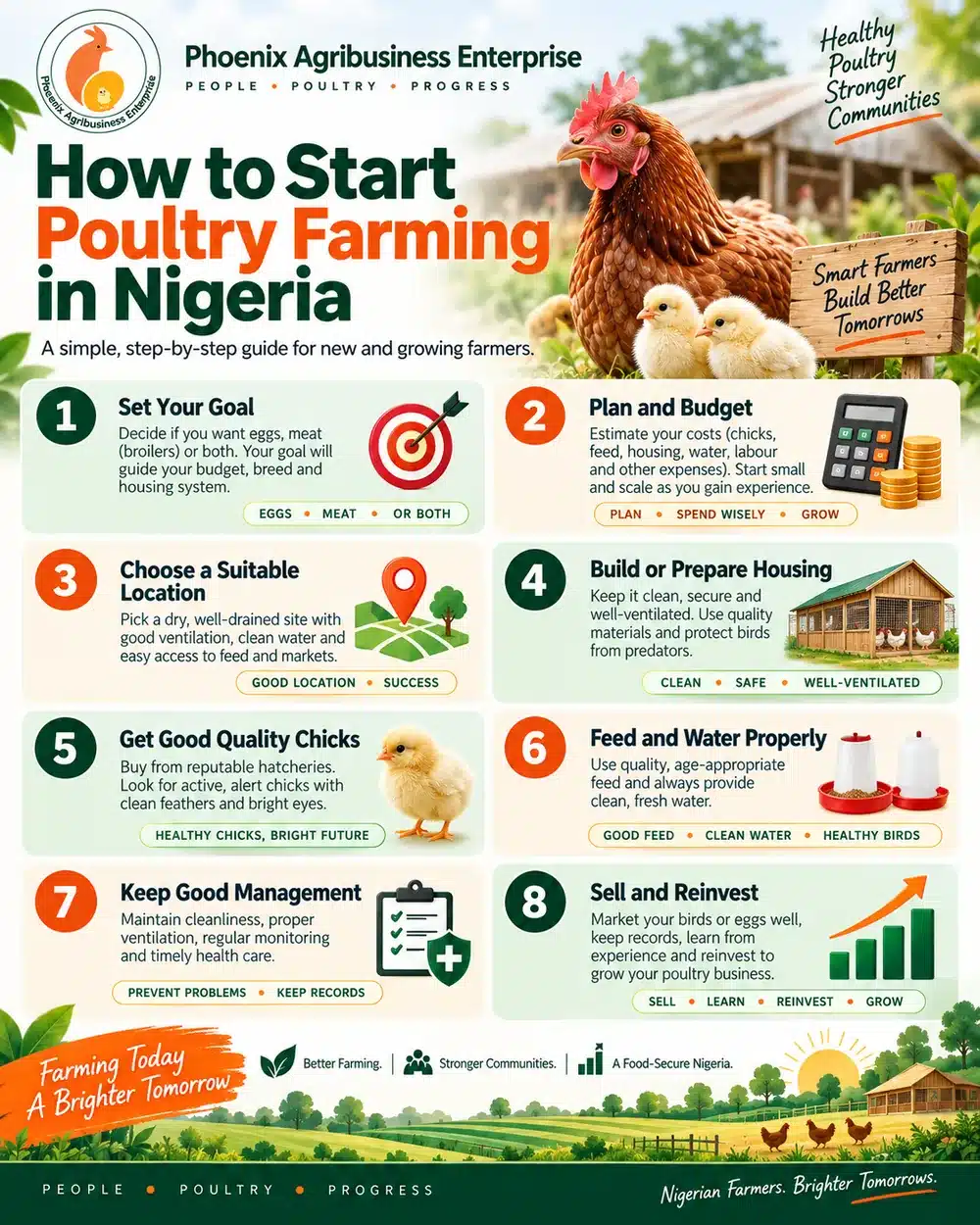
This guide will walk you, farmer to farmer, through the decisions that matter most before you spend heavily: choosing between broilers and layers, setting a realistic scale, planning startup and running costs, selecting a site and housing system, sourcing chicks, preparing feed and water, putting biosecurity in place, keeping records, and planning sales and cash flow.
There is no promise of a fixed profit, one universal stocking rate or one “correct” Nigeria wide price here. Poultry performance and prices vary by location, season, supplier, production system and management. The aim is to help you build a plan you can defend with your own numbers.
Let’s get into it.
Quick answer: what should you decide before spending money?
Before you buy land, cages, feed or day old chicks, be able to answer these questions:
- What exactly will I sell: broilers, eggs, point of lay birds, breeding stock or another poultry product?
- Who is likely to buy from me, and how often?
- How much money can I keep available for running costs, not just construction and equipment?
- Where will I get reliable water, power or backup energy, feed and chicks?
- What housing system suits my scale and climate?
- What is my plan for biosecurity, mortality, waste and veterinary support?
- How will I keep production, feed, mortality and sales records?
- What will I do if feed prices rise, birds grow more slowly than expected or buyers delay purchases?
If several of those answers are still unclear, do more planning before placing chicks.
Choose your poultry business model first
Chicken farming is the main focus of this guide because broiler and layer enterprises are the most common commercial entry points for beginners. Poultry also includes turkeys, guinea fowl, ducks, quail and other birds, but each has its own market and management requirements.
Broiler farming
Broilers are raised mainly for meat. They have a relatively short production cycle compared with layers, so they can suit a farmer who has a reliable meat market and enough working capital to fund a complete batch from placement to sale.
The main business risk is that much of your money is tied up before sale. Feed, chick, energy, health and labour costs accumulate while the birds are growing. If the market is weak at the point of sale, keeping heavy birds longer can increase feed cost and reduce your margin.
If broilers fit your market, the Profitable Broiler Farming in Nigeria guide takes you deeper into the production cycle and management decisions.
Layer farming
Layers are kept mainly for table egg production. They usually require a longer period of spending before regular egg income begins, but once a flock is in lay, revenue can be more frequent than in a batch broiler system.
Layer performance varies with strain, age, feed quality, lighting, health, heat stress and management. Do not build a business plan around one fixed egg per bird figure copied from the internet. Use the performance guide supplied for the strain you buy and treat it as a benchmark, not a guarantee.
If eggs fit your market, the Layers Farming in Nigeria: Egg Production Guide explains the longer rearing period and the management demands that come with egg production.
Breeders, hatcheries, feed milling and chick marketing
These are real poultry businesses, but they are usually more specialised than a basic broiler or layer startup. Breeder operations require tight reproductive management and biosecurity. Hatcheries need specialised incubation systems and quality control. Feed milling requires formulation, ingredient sourcing, processing equipment and quality assurance. Chick distribution requires dependable logistics and supplier relationships.
A beginner should enter these areas only with the required technical skill, market and capital.
Broilers or layers: which is better for a beginner?
Neither is automatically “more profitable.” The better choice is the one that fits your market, cash flow, management ability and risk tolerance.
| Decision factor | Broilers | Layers |
|---|---|---|
| Main product | Meat | Table eggs; spent hens later |
| Time to regular revenue | Usually shorter batch cycle | Longer setup period before lay |
| Revenue pattern | Mostly batch based | More frequent once flock is producing |
| Cash flow pressure | High during each grow out cycle | High during rearing, then ongoing feed cost during lay |
| Market question | Can you sell birds at target weight and time? | Can you sell eggs consistently at a sustainable price? |
| Management focus | Growth, feed conversion, heat, litter, mortality, market timing | Rearing quality, body weight, lighting, feed intake, egg output, shell quality, mortality |
| Best fit | Farmers with a dependable meat outlet and batch capital | Farmers who can fund the pre lay period and build regular egg customers |
A useful rule: choose the market first, then choose the bird.
Backyard, semi intensive or commercial: what scale fits you?
The old idea that commercial poultry is automatically more profitable is too simple. Larger farms may have scale advantages, but they also expose more capital to feed price changes, disease, labour mistakes and market shocks.
| System | Typical scale | Capital intensity | Management control | Labour | Biosecurity complexity |
|---|---|---|---|---|---|
| Backyard / very small | Small flock | Lower | Moderate | Mostly owner managed | Lower, but often poorly formalised |
| Semi intensive / growing farm | Small to medium commercial flock | Medium | Higher | Owner + hired support | Medium to high |
| Commercial | Medium to large flock | High | High if well managed | Structured workforce | High; failures can affect many birds quickly |
Start at a scale you can finance and supervise properly. A smaller flock with complete feed, clean water, good records and disciplined biosecurity is usually a better learning platform than a large flock funded only halfway.
Step 1: Define your market before buying birds
Your market determines the production model.
For broilers, identify whether you plan to sell live birds, processed birds or both. Ask who buys in your area: households, restaurants, retailers, caterers, hotels, religious organisations, event planners or processors. Check whether demand is steady or concentrated around festive periods.
For layers, identify egg buyers before the flock reaches lay. Possible channels include retailers, bakeries, restaurants, households, supermarkets and wholesalers. Know the crate size, quality expectations, delivery pattern and payment terms buyers use.
Do not rely on “people will buy because everyone eats chicken and eggs.” Demand is real, but your farm still needs specific buyers at specific prices.
Step 2: Build a realistic startup and running cost budget
Separate your budget into one time or long life costs and recurring costs.
One time or long life items
Depending on your system, these may include:
- land purchase or lease;
- poultry house construction or renovation;
- brooding equipment;
- feeders and drinkers;
- cages or nest systems where appropriate;
- water storage and plumbing;
- generator, inverter, solar or other power backup;
- storage space;
- weighing scale and record materials;
- basic cleaning and disinfection equipment.
Recurring costs
These usually include:
- day old chicks or replacement pullets;
- feed;
- litter materials;
- water and energy;
- veterinary and health support costs;
- labour;
- transport;
- packaging or egg trays;
- repairs and consumables;
- mortality and contingency allowance.
Feed is usually the cost item you need to watch most closely. In a 2022 study of commercial egg producers in Nigeria, feed was reported at about 70% of total production cost in that study setting. That is a useful warning, not a universal budget rule: your own share will vary with bird type, location, feed price and management. If you underestimate feed, a flock can run short before it reaches the point where it earns money, so build your budget from current supplier quotes.
Use the Cost of Starting a Poultry Farm in Nigeria guide to structure the budget, then replace example figures with quotes from suppliers in your own location.
A planning framework instead of invented national prices
| Scale | Planning approach | What must be confirmed locally |
|---|---|---|
| Small learning batch | Keep infrastructure simple; preserve working capital | Chick price, feed price, brooding fuel/power, water, local selling price |
| Growing commercial batch | Add labour, storage, stronger water/power backup and transport | Bulk feed terms, buyer capacity, mortality assumptions, labour cost, market timing |
| Larger commercial unit | Formal cash flow plan, procurement schedule, staff roles, biosecurity zones and buyer contracts become more important | Supplier reliability, credit exposure, processing/logistics, waste handling, insurance and contingency |
The number of birds should come after this budget, not before it.
Step 3: Choose a suitable site
A poultry site should make daily management easier and reduce avoidable risk. A rural address is not automatically better, and a blanket statement that poultry farms are nationally prohibited in residential areas would be inaccurate. Planning, environmental, nuisance and waste requirements can vary by state and local authority, so check the rules that apply to your location.
Important site factors include:
- reliable access road for chicks, feed, staff and customers;
- drainage that prevents flooding and standing water;
- dependable water source and storage capacity;
- electricity or backup power where your system needs it;
- enough space for ventilation, waste handling and future expansion;
- practical separation from other poultry flocks and heavy visitor traffic;
- security;
- distance to suppliers and market;
- a plan for manure, dead birds and wastewater.
Avoid choosing cheap land that later creates expensive transport, water or drainage problems.
Step 4: Choose housing and a stocking approach
Good poultry housing protects birds from rain, excessive heat, predators and uncontrolled movement while allowing ventilation and easy cleaning.
Open sided houses are common in warm climates because airflow is important, but the correct design depends on local conditions, roof material, house width, stocking density and production system. The FAO small scale poultry production guide is useful background for housing and management principles, but local climate and farm conditions still decide what works on your site. Orientation can help manage solar heat, but housing should be evaluated as a complete system rather than by one design rule alone.
Common systems include:
Deep litter
Birds are kept on a floor covered with suitable litter material. Deep litter can be used for broilers and for some layer systems. Good litter management is essential because wet litter increases ammonia, foot problems and disease pressure.
Cage systems
Cages are commonly associated with commercial egg production. They require higher equipment investment and careful attention to stocking, ventilation, feeding, watering, manure management and bird welfare requirements.
Free range and semi intensive systems
These are not identical systems. In free range production, birds obtain a larger share of their feed by scavenging and range more widely. In semi intensive production, movement is more controlled and the farmer supplies more of the birds’ feed and management inputs. Both still require shelter, predator control, clean water, disease control and appropriate nutrition. “Free range” does not mean “low management.”
Do not copy a universal birds per square metre figure into your plan without checking bird type, age, house design, climate, ventilation and the guidance for your production system.
Step 5: Buy only the equipment your system needs
A basic poultry unit may need:
- feeders;
- drinkers;
- water tank and distribution line;
- brooding heat source for chicks where required;
- thermometer or environmental monitoring tools;
- weighing scale;
- buckets and cleaning tools;
- boots and dedicated farm clothing;
- disinfecting equipment;
- record book or digital records;
- egg trays and nest equipment for layers;
- emergency lighting or power backup where essential.
Do not spend scarce working capital on automation simply because a larger farm uses it. Automatic feeding, egg collection, cooling and manure systems can improve efficiency at the right scale, but they are not substitutes for enough money to buy feed or manage the flock.
Step 6: Source chicks from a traceable hatchery
The source of your birds can affect the entire production cycle.
A good supplier should be able to tell you the strain, hatch date, relevant vaccination information, handling requirements and where to obtain the breeder management guide. Aviagen’s Ross 308 resources are one example of the breeder guidance farmers can use to check management and chick quality expectations. Look for active, alert, well hydrated chicks that are free of obvious deformities and arrive in good condition, but treat those checks as quality indicators rather than a guarantee of later flock performance.
Do not judge chick quality only by price. A more expensive chick is not automatically better, and a cheap chick can become very expensive if poor quality leads to weak growth, mortality or uneven flock performance.
Recognised Nigerian hatcheries and distributors sell commercial strains and often provide management support. Verify the supplier directly before payment and keep transaction and batch records.
Step 7: Plan feed, water and records before placement
Feed should never be an afterthought. It is commonly the largest operating cost in poultry production, so under budgeting feed can stop a flock midway through the cycle.
Before chicks arrive:
- choose the feed programme appropriate to the bird type and age;
- confirm how much stock you can store safely;
- keep feed dry and protected from rodents and contamination;
- provide enough feeder space to reduce competition;
- ensure clean water is continuously available;
- plan how you will monitor feed use and wastage.
Do not formulate rations from random online recipes unless you understand poultry nutrition and ingredient quality. The detailed poultry feed formulation cornerstone should handle that subject separately.
Keep records from day one
At minimum, record:
- birds received;
- daily mortality and culls;
- feed received and feed used;
- medication or veterinary interventions;
- vaccination records where applicable;
- body weight checks;
- egg production for layers;
- sales;
- expenses;
- customer debts and payments.
Good records are not optional; the Poultry Records guide shows how production and financial records help you spot losses before they become habits.
Step 8: Put biosecurity in place before the chicks arrive
Biosecurity is cheaper to plan before placement than after an outbreak.
Basic controls include:
- limit unnecessary visitors;
- use dedicated footwear or footbaths correctly;
- clean and disinfect houses and equipment between flocks;
- control rodents, wild birds and insects;
- separate new or sick birds appropriately;
- dispose of dead birds safely;
- keep feed and water protected from contamination;
- avoid sharing equipment between farms without cleaning and disinfection;
- maintain appropriate stocking and ventilation;
- seek veterinary diagnosis when disease is suspected.
Do not automatically medicate every sick bird. Isolation may be appropriate, but treatment decisions should be based on diagnosis and professional guidance where needed.
Because these controls work as a system, the Poultry Farm Biosecurity guide gives a fuller farm level checklist for preventing avoidable disease movement.
Step 9: Plan sales, cash flow and contingency
A farm can look profitable on paper and still run out of cash.
Create a simple cash flow calendar showing when major expenses occur and when income is realistically expected. Leave room for price increases, delayed sales, mortality, repairs and emergency purchases.
For broilers, decide before placement what happens if birds reach your target sale period and buyers are slow. For layers, plan for the long pre lay period and for the fact that egg price and feed price can move in opposite directions.
Avoid using borrowed money based only on a best case production result. Build a downside case too.
Common mistakes beginners should avoid
1. Buying chicks before finding a market
Production is easier to plan when you know who is likely to buy the final product.
2. Spending almost all the capital on buildings and cages
A beautiful house does not feed the birds. Protect working capital for feed, water, energy, health, labour and transport.
3. Starting too large
Management mistakes become expensive when multiplied across a big flock. Start at a size you can finance and supervise.
4. Copying another farm’s numbers without context
Feed conversion, egg output, mortality, growth rate and stocking density depend on genetics, age, climate, feed, housing, health and management.
5. Ignoring records
Without records, you may know that money is leaving the farm but not why.
6. Weak biosecurity
Visitors, borrowed equipment, rodents, wild birds and poor cleaning can move disease between flocks.
7. Treating poultry farming as guaranteed profit
Profit depends on biological performance and market performance. Feed cost, mortality, selling price and management can all change the result.
Pre placement checklist
Before chicks arrive, confirm:
- House is cleaned, disinfected, dry and secure.
- Brooding area and heat source are ready where required.
- Water source, storage and drinkers are working.
- Feed is available for the first stage of production.
- Feeders and drinkers are correctly placed.
- Litter is clean and dry for deep litter systems.
- Chicks and supplier details are confirmed.
- Biosecurity entry procedure is in place.
- Record sheets or digital records are ready.
- Vet/animal health contact is available.
- Backup plan exists for power, water or heat failure.
- First buyers and sales channels have been identified.

A simple poultry startup flow
Market → Production model → Budget → Site → Housing → Equipment → Chicks → Feed & water → Biosecurity → Records → Production → Sales → Review
If you reverse that order and begin with chicks, you may discover expensive problems after the birds are already depending on you.
When should you use a poultry cost or break even calculator?
Use a calculator when you have real local inputs, not guesses. Enter your actual chick price, feed cost, expected feed use, mortality assumption, labour, energy, transport and expected selling price.
Run at least three cases:
- Base case: the result you realistically expect;
- Stress case: higher feed cost, slower growth or lower selling price;
- Better case: improved performance without assuming perfection.
A farm that only works in the best case scenario is fragile.
What should you read next?
If you have chosen broilers, use the Profitable Broiler Farming in Nigeria guide to turn this startup plan into a production plan.
If you are considering egg production, the Layers Farming in Nigeria guide helps you plan the rearing to lay transition and ongoing egg production management.
If your main question is money, the Cost of Starting a Poultry Farm in Nigeria guide helps you separate infrastructure spending from the working capital needed to keep birds fed and managed.
Before placement, use the chick brooding guide to prepare the brooding environment and the biosecurity guide to close obvious disease entry gaps.
Frequently asked questions
How much money do I need to start poultry farming in Nigeria?
There is no responsible single national figure. Your required capital depends on bird type, flock size, housing, whether you already own land or equipment, local chick and feed prices, energy, labour and how much contingency you keep. Build the budget from current local quotes.
Is broiler farming more profitable than layer farming?
Not automatically. Broilers and layers have different production cycles and cash flow patterns. Profit depends on feed cost, mortality, technical performance, market price, debt, labour and management.
Can I start poultry farming at home?
A small flock may be possible where local rules, space, waste management, neighbour impact and biosecurity allow it. Check planning and environmental requirements that apply in your area before expanding.
Should I buy cheap chicks to reduce startup cost?
Price alone is a poor quality test. Buy from a traceable supplier that can identify the strain, hatch date and relevant management information. Poor chick quality can cost more later through mortality and poor performance.
Do I need a vaccination schedule before I start?
You need an appropriate health plan, but do not copy a generic schedule without confirming the birds, disease risks, hatchery vaccination status and local veterinary guidance. This broad startup guide deliberately does not prescribe a vaccination timetable.
What is the biggest running cost on a poultry farm?
Feed is often the largest operating cost in commercial poultry production, but the share varies by enterprise, location and period. That is why feed procurement, storage, wastage control and cash flow planning are central to the business plan.
Conclusion
Poultry farming in Nigeria can be a viable business, but success does not come from flock size alone. A beginner is better served by a clear market, realistic working capital plan, suitable housing, reliable chicks, disciplined feed and water management, strong biosecurity and accurate records.
Start at a scale you can manage well. Measure what happens. Learn from each cycle. Expand only when your records: not excitement: show that the system is working.
Sources used to check this guide
- FAO. Small scale poultry production: production systems, housing, feeding, health, economics and marketing.
- FAO. Farmer field schools for family poultry producers: practical producer management and local adaptation.
- Aviagen. Ross 308 resources and performance objectives: breeder benchmarks only, not guaranteed Nigerian results.
- Nigerian peer reviewed poultry economics studies identified in the C2.1 source pack: used to support the statement that feed and other variable inputs dominate operating costs and that profitability is context dependent.
- Current market prices, if later added, must be dated, location specific and visibly sourced at publication time.